


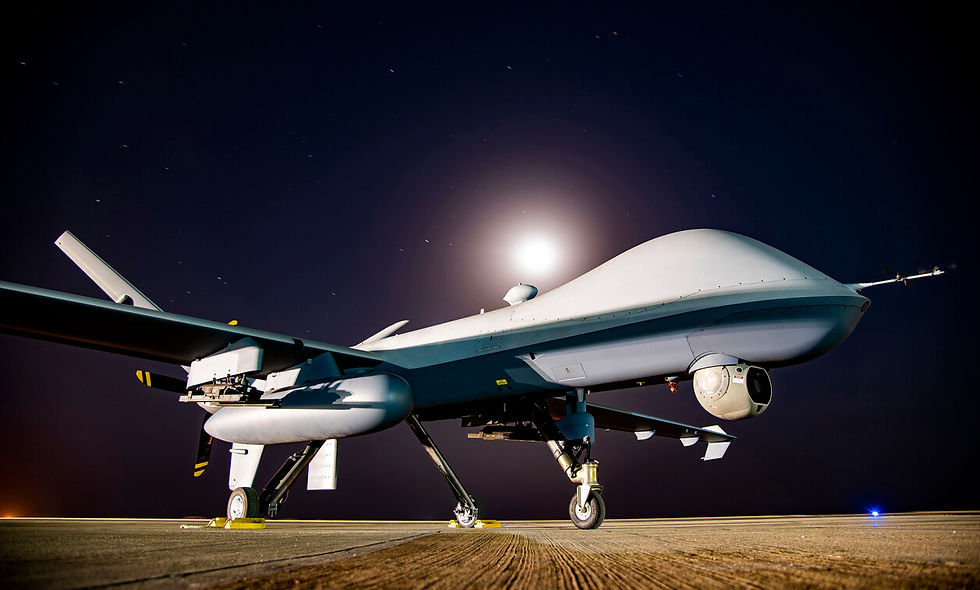
Drones/UAV
Semiconductors in Drones/UAV
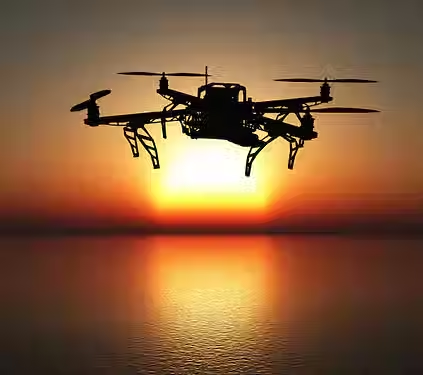
Revolutionizing Industry Operations with Semiconductors
Drones, also known as Unmanned Aerial Vehicles, is an aircraft with no human pilot, crew, or passengers onboard. Drones can be controlled remotely via a remote control on the ground or autonomously by onboard systems. The use of drones has significantly increased over the years in many industries from agriculture (crop health), construction (progress tracking, surveying), energy/utilities (power lines, turbines), public safety/emergency response (search & rescue, disaster assessment), real estate/tourism (marketing, site views), logistics (delivery), and the military. The use of drones has gained popularity for their ability for being able to perform various functions such as aerial data, inspections, or remote monitoring, which are required by all the mentioned industries. By implementing the use of drones, many industries can enhance safety, cut costs, and boost efficiency by not having to rely on humans to undertake hazardous manual work. Drones can do remote inspections such as wind turbines, oil rigs, and power lines, provide high-resolution mapping/surveying, record real-time site surveillance, do asset monitoring, can collect data rapidly while performing work faster with more accurate aerial assessments. They provide data for better decision-making, from detecting faulty solar panels to monitoring construction progress, and even delivering materials. Of course, the backbone of drones depends on evolving semiconductor technology, changing the way many industries conduct operations, as new types of drones are being developed to cater to specific needs and technological advancements.
Zener Core Competencies in Drones/UAV

Giving Aerial Operations An Edge
Core semiconductor competencies for drones/UAV's lie in producing highly integrated, power-efficient, and powerful electronic components that enable advanced functionality within demanding size and weight constraints. Here at Zener Engineering, we provide the following services in drones/UAV's:
-
System-on-Chip (SoC) and System-in-Package (SiP) Integration: Combining multiple functionalities like processing, memory, and connectivity onto a single chip or within a single package reduces size, weight, and power consumption (SWaP), which is crucial for maximizing flight time and payload capacity.
-
High-Performance Edge Processing: Developing AI-specific chips and Field-Programmable Gate Arrays (FPGAs) that can process large amounts of data from various sensors (cameras, LiDAR, radar, etc.) in real-time at the edge. This on-board processing enables low-latency decision-making for tasks like obstacle avoidance, object recognition, and autonomous navigation.
-
Sensor Fusion and Data Acquisition: Expertise in integrating chips that can interface with and fuse data from diverse sensors such as accelerometers, gyroscopes, magnetometers, and GPS modules. This provides accurate situational awareness and flight stability.
-
Efficient Power Management ICs (PMICs): Designing specialized power management integrated circuits to ensure efficient energy usage, which is critical for extending operational range and endurance.
-
Secure and Resilient Operation: Competencies in creating secure boot mechanisms, authenticated firmware, and radiation-tolerant designs for reliable operation in potentially harsh, contested, or sensitive environments, particularly for military and industrial applications.
-
Robust Communication Protocols: We design chips that support various communication technologies (Wi-Fi, proprietary RF systems, etc.) while minimizing electromagnetic interference (EMI) to maintain reliable links with ground stations or other systems
Drone vs UAV

Making Aerial Operations More Efficient
The term drone has become synonymous with an aerial device that is controlled remotely and flies without a human pilot. Although drones and UAV (Unmanned Aerial Vehicle) are the same, in that drones are a type of UAV, the difference lies in how the terms are applied. The term "drone" is a more commonly used colloquial term, whereas UAV is a broader, more technical term used by industry professionals and regulatory bodies. "Drone" is a broad, informal term commonly used in consumer and commercial contexts. "UAV" (Unmanned Aerial Vehicle) is a more technical term, often used in aerospace and regulatory frameworks. All UAVs can be called drones, but not all drones strictly qualify as UAVs depending on the context, especially when distinguishing between vehicles and systems.
It is further important to stress that all UAV's are drones, but not all drones are UAV's because a UAV is an unmanned aerial vehicle, but drones that are used for underwater purposes, such as in marine exploration, are not UAV's, because they are not aerial. This is why it is critical to make this discussion when the topic of drones comes up, since UAV is a more broader term, whereas drones can be specific types of unmanned devices, but not necessarily aerial.
In order for a drone to be considered a drone, it has to have certain characteristics, such as the following:
-
Unmanned Operation: A drone operates without a human physically present in or on the vehicle.
-
Aerodynamic Flight: It generates lift and propels itself through the air using aerodynamic forces, whether via rotors, wings, or other means.
-
Versatile Environments: Drones can operate in air, water, or on land, encompassing a wide range of vehicles, from quadcopters to autonomous submarines.
-
Purpose-Driven Design: Drones are designed for specific tasks, such as photography, surveillance, delivery, or exploration, often equipped with sensors, cameras, or other payloads.
-
Controlled Operation: It's not simply a free-flying object; its flight path and operations are managed, either by a remote pilot or an autonomous system.
Role of Semiconductors in Drones/UAV

Semiconductors...Changing the Evolution of Drone Technology
Semiconductors are essential to the functionality of drones/UAVs, acting as their "brains" and enabling core capabilities like autonomous navigation, real-time data processing, and efficient power management. The increasing demand for advanced features like AI and enhanced sensor integration drives continuous innovation in semiconductor technology. Semiconductors enable everything from basic flight control to advanced autonomy by powering processors, sensors (like CMOS, LiDAR), AI for decision-making, energy management (MOSFETs), and secure communication, allowing for real-time data processing, obstacle avoidance, stable flight, and longer endurance, essential for complex tasks like mapping, delivery, and surveillance. As drone technology continues to advance, IC chips are evolving to meet the demands of increasingly sophisticated drone applications. Manufacturers are developing specialized chips tailored to specific drone functionalities, such as artificial intelligence (AI) chips for autonomous decision-making or computer vision chips for advanced image processing.

Key Characteristics
-
High Power Efficiency: To overcome limited battery capacity and extend flight range/endurance, semiconductors are designed to consume minimal power. Wide-bandgap materials like silicon carbide (SiC) and gallium nitride (GaN) are increasingly used in power electronics for their superior efficiency and lower switching losses.
-
Compact Size and Low Weight: Semiconductors must be highly integrated and lightweight to fit within drone design constraints without sacrificing payload capacity or agility. Miniaturization is a continuous goal in chip design for UAVs.
-
Fast, Real-Time Processing: Drones require powerful processing capabilities to handle vast amounts of data from multiple sensors (LiDAR, cameras, GPS, etc.) instantaneously for autonomous navigation and real-time decision-making. This often involves specialized chipsets (like application-specific integrated circuits or chiplets) designed for high-speed data processing and AI acceleration.
-
Reliability and Durability: Drone semiconductors must withstand harsh environmental factors during flight, including extreme temperatures, humidity, and vibrations. Components like Tantalum capacitors are used for their reliable performance under such conditions.
-
Advanced Sensor Integration: The chips are integral to smart sensors that provide critical data for navigation and obstacle avoidance.
-
Tunable Conductivity (General Semiconductor Property): At a fundamental level, the ability to control electrical conduction (via doping and band gap manipulation) is what makes semiconductors ideal for building complex, controlled electronic components like transistors, diodes, and integrated circuits that make up all drone electronics.
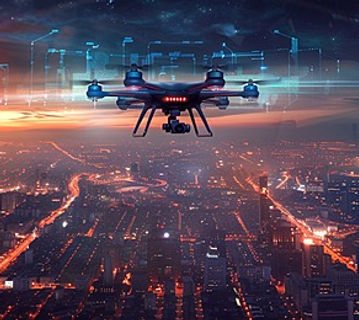
Core Functions
-
Flight Control and Processing: Microcontroller Units (MCUs) and System-on-Chip (SoC) integrated circuits serve as the main flight controllers, executing flight algorithms and handling core navigation tasks. Advanced AI chips, which are highly optimized semiconductor processors, provide the computational power needed for real-time decision-making, object recognition, and complex autonomous operations without human intervention.
-
Sensing and Data Acquisition: Semiconductors are integral to the various sensors that allow a drone to perceive its environment. These include:
-
Image Sensors: CMOS and CCD image sensors used in cameras for photography, videography, surveillance, and computer vision.
-
Navigation Sensors: Micro-Electro-Mechanical Systems (MEMS) accelerometers and gyroscopes for inertial navigation systems (INS), as well as GPS modules for precise location and timing information.
-
Environmental Sensors: Altitude, temperature, pressure, and LiDAR (Light Detection and Ranging) sensors for gathering real-time environmental data and obstacle avoidance.
-
-
Communication: Radio Frequency (RF) semiconductors are essential for wireless communication between the drone and the ground station or other drones. They facilitate the transmission of control signals and the reception of data, often using advanced materials like gallium nitride (GaN) for high-frequency, reliable signal transmission.
-
Power Management: Power Management ICs (PMICs) and other power electronic components (like tantalum capacitors and high-efficiency GaN power semiconductors) regulate voltage and current flow, ensuring efficient energy usage to extend flight duration. They are critical for managing the power from batteries or integrated solar panels.
-
Propulsion: Semiconductors are found in electronic speed controllers (ESCs) that manage the power delivered to the electric motors, optimizing performance, power density, and efficiency for flight.
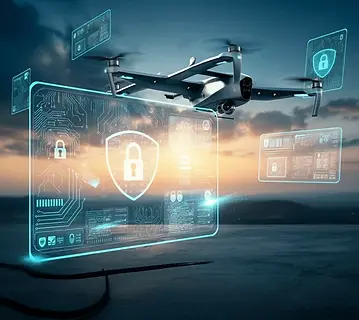
Applications
Core Processing and Control
-
Microcontroller Units (MCUs) and System-on-Chip (SoC): These are the "brains" of the drone, handling essential tasks like flight control, navigation, and real-time data processing. SoCs integrate multiple functions (CPU, GPU, memory) onto a single chip to reduce size and optimize performance.
-
AI Chips/Processors: Specialized chips, including Neural Processing Units (NPUs) and Tensor Processing Units (TPUs), enable on-board artificial intelligence and machine learning. This allows for autonomous navigation, object recognition, obstacle avoidance, and complex decision-making without relying on cloud connectivity.
-
Memory and Storage: Semiconductor-based memory devices store flight algorithms, operating systems, and collected data.
Sensing and Data Acquisition
-
Image Sensors: High-resolution image sensors (CMOS, CCD) and advanced vision systems use semiconductors to capture aerial imagery and video for photography, surveillance, mapping, and inspection.
-
LIDAR (Light Detection and Ranging) and Radar Systems: These systems use semiconductor components to create detailed maps of the environment, detect objects, and facilitate precision navigation and obstacle avoidance.
-
Environmental and Motion Sensors: Drones rely on various semiconductor-based sensors, including:
-
Gyroscopes and Accelerometers: For flight stabilization and inertial navigation systems.
-
GPS Receivers: For precise location tracking and navigation.
-
Environmental sensors: Such as temperature, humidity, and nutrient sensors for applications like precision agriculture.
-
Communication and Connectivity
-
Wireless Communication Chips: Semiconductors enable communication between the drone and ground control stations (GCS) or other drones via Wi-Fi, Bluetooth, proprietary RF systems, and 5G networks.
-
Secure Communications: Hardware-level security features built into secure semiconductors help protect communication links from interception or jamming, especially in military applications.
-
Data Links: Communication chips facilitate the real-time data transfer of sensor information, video streams, and command signals.
Power Management and Reliability
-
Power Management ICs (PMICs): These chips ensure efficient energy usage, regulating voltage and current to extend battery life, which is critical due to limited power and weight constraints.
-
Circuit Protection Devices: TVS (Transient Voltage Suppression) diodes and other protection devices safeguard sensitive electronics from power surges and transient events, ensuring reliable operation in demanding conditions.
Specialized Applications
-
Military Systems: Semiconductors are crucial for defense applications like surveillance, reconnaissance, target identification, and enabling secure and radiation-resistant systems for use in hostile environments.
-
Industrial Automation: In construction, logistics, and agriculture, specialized chips process data for site mapping, inventory management, and crop monitoring, leading to improved efficiency and productivity.